
| Feedback
and Natural Processes |
|
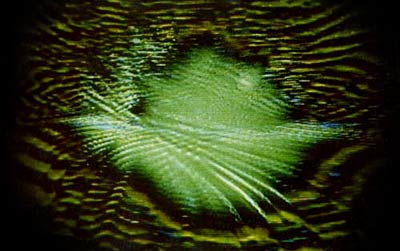
These insights were enhanced by my early exploration of the phenomenon of video feedback, of which I somewhat immodestly claim to have been the world’s leading exponent during the Seventies. [Video feedback occurs when a camera is pointed at a TV monitor displaying its own output – it is equivalent to the squealing noise that occurs when a microphone is placed too close to an amplified loudspeaker playing the output of the microphone.] Video feedback is now recognised as a “classic” fractal phenomenon. The complexity and instability of video feedback requires a particular approach when its use is attempted in a performance situation as it can be present one instant and gone the next - very chaotic in fact! Despite these practical difficulties, feedback remained a constant component from my first videos to my latest – it often just gets used very subtly, so is not obviously apparent. This consistent use is because it adds a “naturalistic complexity” to simpler forms, which thereby reflect those found in nature. I always describe my “abstract” videos as seeking to express on the one hand archetypal forms and on the other fundamentally natural forms. This apparent riddle was only really explained through the eventual work of some pioneering mathematicians in the Eighties. Essentially, fractal mathematics describes the complex processes that define what makes the natural world look natural to us! By using video feedback I was paralleling how those process work in nature, so my “abstract” images felt very natural to me even when they did not represent anything directly in nature.
Good reading: Fractals, the Patterns of Chaos, John Briggs, Thames and Hudson, 1992 Chaos, Making
a New Science, James Gleick, Heinemann, 1988
|